Showing posts with label It's about the issues. Show all posts

Tuesday, October 31, 2006

Do you really need one more red flag: Christians in the Horn


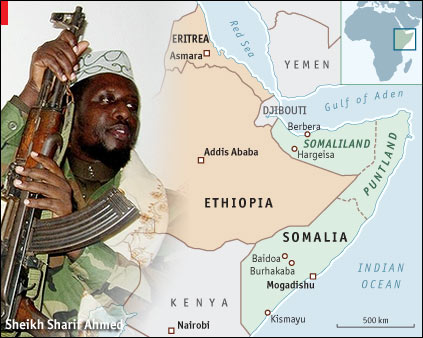
While everyone is screaming over Iraq, another huge conflict exists in the Horn of Africa. I will attach a link here if you don't know much about it. (The Economist article)
Long story short: Somalia has a new bully in town, and they are called the Union of Islamic Courts. They are a militant Islamic group that steadily gained support and took over at breath taking speed beginning in the capital of Mogadishu. This has culiminated in thousands fleeing from the group, including Christians who have taken refuge in camps on the border of Kenya and Ethiopia (mostly Kenya).
Ethiopia, threatened by the UIC moving closer and closer to their border has risen to help the rag tag "transitional" Somali government. The UIC has now declared Holy War on Ethiopia. Eritrea, a long time enemy of Ethiopia is giving arms to Somalia. There have been reports of ERitrean troops moving to the border. This could engulf the whole Horn.


Unfortuanety this is affecting many Christians on the border of Somalia, and elsewhere in Nairobi and Addis where Muslims are rising up against Christians. There has been a surge of violence against Christians in the Oromo region of Ethiopia and to the East as well. An Ethiopian pastor has been corresponding with me and just sent me pictures of a massacre that took place a month ago. I will spare you the pictures, because they are really disturbing. But truely. Pray for Ethiopia and for Christians in the Horn becuase this is a difficult hour and many are suffering for the sake of the gospel.


Monday, August 07, 2006

Promises not kept

Khartoum is cashing in on the oil boom, which is bringing revenue and infrastructure into the capital. Meanwhile the South faces incredible poverty and the demands of rebuilding a nation that is completely devastated from over twenty years of bombing and attacks. It is barely benefiting at all from these monies. One of the stipulations of the CPA was wealth sharing in regards to oil revenue.

An island unto itself
Aug 3rd 2006 KHARTOUM
The Economist

The capital benefits most from an economic boom


The conversations tend to be very different, but very predictable, when Khartoum's bourgeoisie gathers for espressos and croissants at the trendy new Ozone cafĂ©. Americans and Europeans, mostly aid-workers, swap horror stories about the latest depredations in Darfur, Sudan's war-ravaged western region, or bemoan southern Sudan's “lack of capacity”. At the Sudanese tables, however, Arab men, and often women, josh about their city's brand-new traffic lights, which most still ignore, share information about new government privatisations and greet old friends who have returned to live in the Sudanese capital after years abroad.


Khartoum moves up in the world
Both views of Sudan, Africa's largest country, are valid. It is just that the Western focus on Darfur, where about 2m people are living in refugee camps as the result of a still unresolved war in the region, has obscured another fact about Sudan: the country is booming. With low inflation, GDP growth of 8% in 2005 and 13% projected by the IMF this year, Sudan is one of the fastest-growing economies in Africa. Furthermore, this success has been achieved despite the fact that the country has been subject to American sanctions since 1986, the year that the IMF ended financial assistance to the country.

Oil undoubtedly plays a big part in this boom, accounting for about 80% of the country's exports, but it does not explain all the gains. Indeed, the IMF has given guarded praise to the policies initiated by Sudan's government to liberalise the economy. It is not the kind of attention that the Islamist regime in Khartoum, accused of genocide by America for its actions in Darfur, is accustomed to.


Oil, structural adjustments that began in 1998 and the relative political stability that followed the signing of a peace deal with rebels in the south last year are encouraging foreign investment, particularly from China and the Gulf states. More needs to be done to tackle corruption and eliminate stifling regulations, yet new economic opportunities are enticing thousands of the country's rich and educated diaspora to return. More and more, Sudan's ruling National Congress Party is toning down its hitherto robust Islamist language; the new emphasis is on economic development.

However, it is almost exclusively the Arab heart of the country that is benefiting from the boom. Nearly $3 billion of foreign direct investment has come to Sudan, but well over half of it has gone to the capital and its hinterland. In the past year hotels, telecoms companies, light industries and even a Thai massage parlour have opened in a city that is still nominally ruled by sharia law.

The development that most epitomises Khartoum's new dynamism is Alsunut. Meaning “point of meeting” in Arabic, this behemoth of a residential and office project is now under construction on 65 hectares (160 acres) of land where the Blue and White Niles converge. The $4 billion project, the result of a public-private partnership between the government and DAL Group, Sudan's leading company, will transform the city by adding 63 towers varying between 15 and 35 floors in height. Over half the office space has already been sold to local and foreign companies.

However, for all the new prosperity in Khartoum, evidence of the boom outside the capital is hard to find. Progress towards improving the lot of the majority of poor Sudanese is plodding. For most people, electricity is still rare and most schools still hold classes under trees.

And, crucially, Sudan's improved economic outlook has not had any discernible impact on the mainly Christian and animist south. Hundreds of thousands of displaced southern Sudanese are leaving their refugee camps in the north and returning to what remains one of the poorest areas in Africa. Indeed, the pace of recovery in the south is so slow that some aid agencies report that villagers have started throwing sticks and stones at their passing convoys as a form of protest.

The inequitable distribution of the country's wealth has always been a large factor in stoking rebellions in the south, in Darfur and in the east against the central government in Khartoum. If that remains true of this current boom—which may last only as long as the high price of oil—it will be a huge missed opportunity to reduce some of the inequalities that still threaten to pull the country apart, with disastrous consequences for all Sudanese.

Friday, August 04, 2006

State within a state

The world news is sobering these days.

I've been wondering if Israel is suprised at the strength of Hezbollah, and if they really destroy the stronghold in Lebanon, it they will then go into Iran. I read something interesting about Hezbollah today on the BBC, how they maintain loyalty among the Shia community, that is: feed them, clothe them, take of them, ect... Keeping the government and the people in submission.

Hezbollah is not only a military group, and not only a political party; it also has social services that it provides for its supporters, Lebanon's Shia Muslims. Hezbollah has a full infrastructure that gives these people every possible means to keep standing Hussein, member of HezbollahAt one Beirut school, 1,500 people are living in a refugee centre run by Hezbollah. "The group has engineers, it has workers," says Hussein, one of the Hezbollah members running the centre. "Hezbollah has a full infrastructure that gives these people every possible means to keep standing." Another woman told me that even though they were refugees, Hezbollah was giving them everything they needed. The government had limited means, so Hezbollah was helping them, she said. This is how Hezbollah guarantees unwavering loyalty and popular support - by providing for the Shia community. The central government has been weak here for decades so it is easy for Hezbollah to step in. But there is also a sense that Hezbollah monopolises the Shia and keeps the government at bay with its schools, hospitals and women's associations. And with its substantial arsenal of weapons, many Lebanese see the group as a state within a state.


Monday, July 31, 2006

Two minutes

Every two minutes a child will die in the Congo.

Every day 1,250 people die in the silent war of Africa, that has taken more lives in a war since World War II. In a report released in July, Unicef described the death toll in Congo as a “tsunami of death every six months.” In all, nearly four million people have died as a result of the conflict since 1998, almost half of them children under the age of 5, according to the International Rescue Committee.

According to the article: "About 30,000 children have been forced into militias, while untold thousands of girls have been raped, according to the Unicef report. Children labor under toxic conditions in gold and diamond mines. Orphans choke the streets of Kinshasa, the capital, bedraggled platoons in Congo’s vast army of want. "

This is depressing to start out on a Monday, but i read this in the NY Times last night and I was heart broken. These children need our prayers.

Tuesday, July 25, 2006

A newbie among the learned

First of all - I just found out my old pastor from college is reading my blog!! Lakan - We will touch base because I want to talk about the Philippines and other stuff, I will call you!!

So, yesterday was a good day. I went to this briefing put on by the ambassador at large for the state dept's bureau for international religious freedom. My boss was supposed to go, but because he had just gotten back in town, i was appointed to go, which stressed me out. I'm still having difficulty meeting people at these things, because inside my head i am thinking, "man, i'm just a newbie at this whole thing, they are going to figure that out as soon as i start talking." so as i was walking down Pennsylvania Avenue, i psyched myself up to be bold.

The meeting was good, but the more important thing was that i got to meet people in the Intl Freedom dept/ State Dept. that worked for interests in the region in which I am focused. Then, there was another guy who I had begun a conversation with before the meeting started. We had exchanged info, but he had his intern call our office to arrange a meeting to talk more about what we had discussed. I didn't realize that he was the director of an organization that we had been wanting to work with which is very cool.

In case you are wondering, the people i met were quite gracious, especially, one of the older gentlemen i spoke with who was finishing up his last year at the state dept. good people.

Anyhow it was a good day, and I am glad my boss had other plans...

Friday, July 21, 2006

Sweaty girl on the Hill

I'm just a sweaty girl on Capital Hill.

This won't mean much to alot of you, but I made the mistake of getting off at Union Station this morning. Little did i know that the Rayburn building is far away from Union Station, like really far away in the blazing heat and i am walking in a suit. i walked by the Dirksen building and someone told me that Rayburn was just two blocks down, but in the heat it might as well have been 6-8 blocks. By the time we got to the building I looked like I had gotten out of the shower. My sidekick, intern Veronica was merely red in the face. No perspiration to be seen. Unfortunately, the Italian side of my family sweats profusely. My hair was no longer dry and I was definitely convinced that people would have known i was the room because they could smell me. Yikes.

This morning i visted the Rayburn office on the Hill for a hearing on persecution of Dalit Christians in India. Alot was really new to me, because that isn't my region, but i was glad to be there. The Dalit class is the lowest in the India Caste System. Society has labeled them as the "untouchables", but they have named themselved "Dalit" meaning oppressed. It seems there is a great deal of complexity with persecution of Christians and other minority groups in India. The national rhetoric is that there is religious freedom but on the state and local levels this is not the case. India is now creating new anti-conversion laws, redefinding what "forced conversions" are. Christians can be imprionsed for sharing their faith, under the claims of "emotional coercion", if they are establishing relationships with seekers.

Something striking that was said in the conference was that one-third of social work done in India is done by Chrisitans (who represent 3-5% of the population).

Also: there is a House Bill coming up on the floor for a agreement between India and the United States on nuclear arms next week. I wonder how we can enconomically put pressure on India, so that they might take the issue of persecution seriously.

Wednesday, June 21, 2006

National Religious Freedom Day on Capitol Hill

Yesterday was National Religious Freedom Day on Capitol Hill.

Impacting moment of the day: A Syrian woman, Wafa Sultan got up to the podium and like a prophet spoke of the hatred and oppression Islamic extremism brings to her people, especially to women and children. You could hear a pin drop in the room. Her words seared the air. After she finished i discovered i had tears streaming down my face.

She has been seen on Middle Eastern television, and i wonder how much longer she has on this earth...